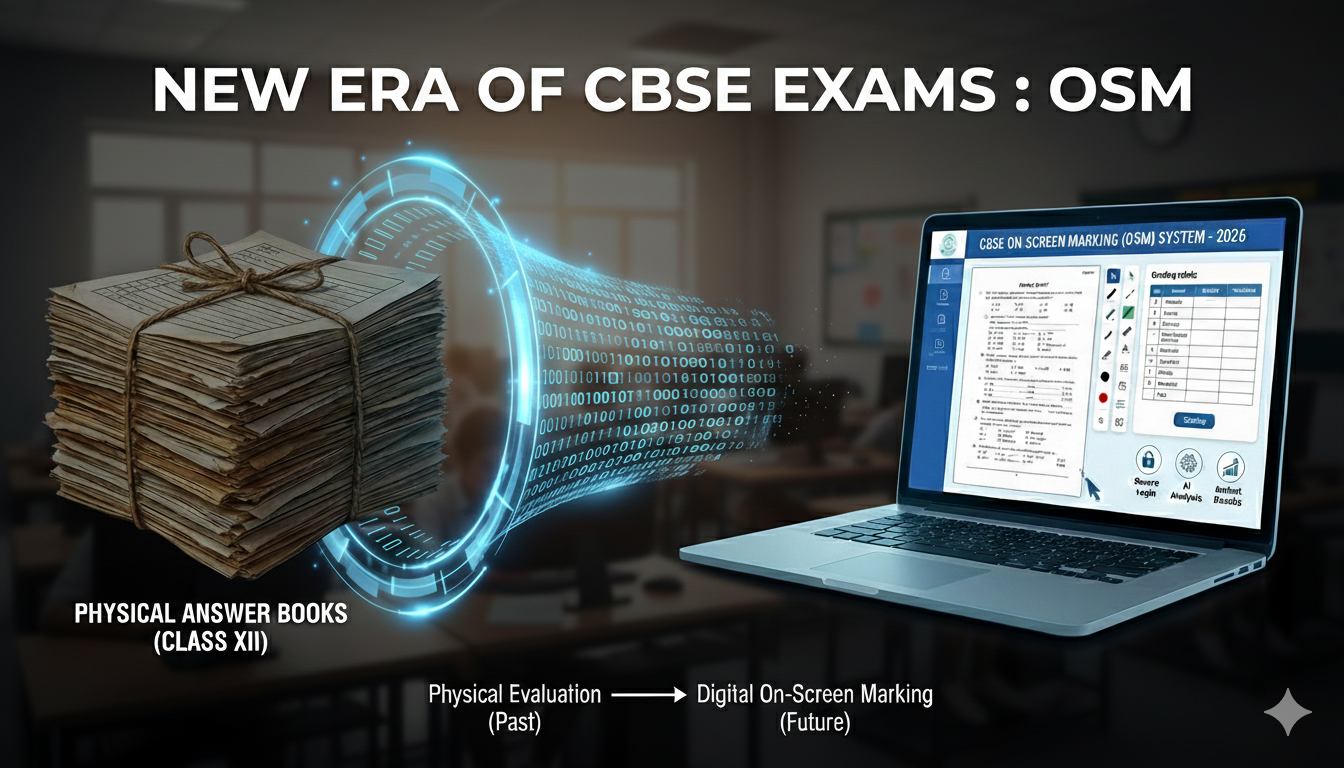
CBSE has formally announced a major change in the Class 12 board exam evaluation process. As per CBSE’s circular dated 09 February 2026 (Subject: Introduction of On-Screen Marking (OSM) for Class XII Examinations), Class XII answer books will be evaluated through On-Screen Marking (OSM) starting with the 2026 examinations, while Class X evaluation will continue in physical mode in 2026.
This is not just an administrative update. For principals, directors, and school owners, OSM becomes an operational readiness requirement: school IT infrastructure, teacher access, and lab connectivity must be prepared so your staff can participate smoothly when CBSE begins logins, dry runs, training, and live evaluation.
What is CBSE On-Screen Marking (OSM)?
On-Screen Marking (OSM) is a digital evaluation process where examiners assess scanned answer books on a secure online system instead of checking physical copies. CBSE’s objective is to improve efficiency, transparency, and standardization at national scale.
CBSE highlights the scale of board exams as context: the Board conducts Class X and XII exams annually in India and across 26 countries, catering to nearly 46 lakh students.
Official CBSE Announcement (Verified Details)
From the circular (CBSE/COORD/OSM/2026 4393/ dated 09.02.2026):
1) Scope of rollout in 2026
-
Class XII: OSM will be used for evaluation starting 2026.
-
Class X: evaluation remains physical in 2026 (as before).
2) Why CBSE is moving to OSM (benefits listed by CBSE)
CBSE lists the following envisaged benefits of OSM:
-
Elimination of totalling errors
-
Automated coordination, reducing manual intervention
-
Faster evaluation with wider teacher participation
-
Teachers can remain in their schools and continue regular duties
-
Savings in transportation time and costs
-
Post-result verification of marks will no longer be required
-
Reduced manpower requirement for verification
-
Opportunity for all schools to contribute to evaluation
-
Involvement of teachers from all affiliated schools globally
-
Environmentally sustainable digital evaluation
CBSE School Readiness Checklist (Minimum Technical Requirements)
CBSE has explicitly requested schools to ensure readiness in the following areas:
A) Lab and network requirement
- Computer lab with Public Static IP (as per Affiliation Bye-Laws)
B) Device requirements
-
PC/Laptop with Windows OS 8 or above
-
At least 4 GB RAM
-
At least 1 GB free space on C:/ drive
C) Software requirements
-
Latest browser (Chrome/Edge/IE/Firefox listed by CBSE)
-
Adobe Reader
D) Connectivity and power
-
Reliable internet connectivity: minimum 2 Mbps
-
Uninterrupted power supply (UPS/inverter support)
Practical note for schools: Treat the above as the minimum baseline. For smooth examiner experience (especially during peak windows), aim for stable bandwidth, tested backup connectivity, and controlled lab access.
CBSE Implementation Support: What CBSE Will Provide
CBSE has stated it will facilitate implementation through the following:
-
System access for teachers with OASIS IDs to log in and familiarise themselves
-
Multiple dry runs for practice
-
Training programmes to explain the system
-
A call centre for issue resolution
-
Instructional videos for better understanding
-
CBSE also notes that detailed instructions for each activity will be issued separately
What Principals and Directors Should Do Now (Action Plan)
Here is a school-friendly plan you can execute without waiting for further circulars.
1) Confirm IT compliance in one audit
-
Validate Public Static IP availability for the computer lab.
-
Identify the exact number of usable Windows systems meeting Windows 8+, 4 GB RAM+, and available disk space.
-
Verify browser updates and Adobe Reader presence.
-
Measure actual internet speed during school hours; confirm it meets or exceeds 2 Mbps reliably.
2) Create an "OSM Lab Readiness" SOP
-
Dedicated lab slots for CBSE activities (login familiarisation, dry runs, training).
-
Power backup protocol and escalation contacts.
-
Device checklist and quick troubleshooting guide for invigilators/IT support.
3) Prepare teacher readiness (operational, not just technical)
-
List teachers with valid OASIS IDs and ensure they can log in.
-
Assign a school coordinator for OSM activities: scheduling, compliance, issue logging.
-
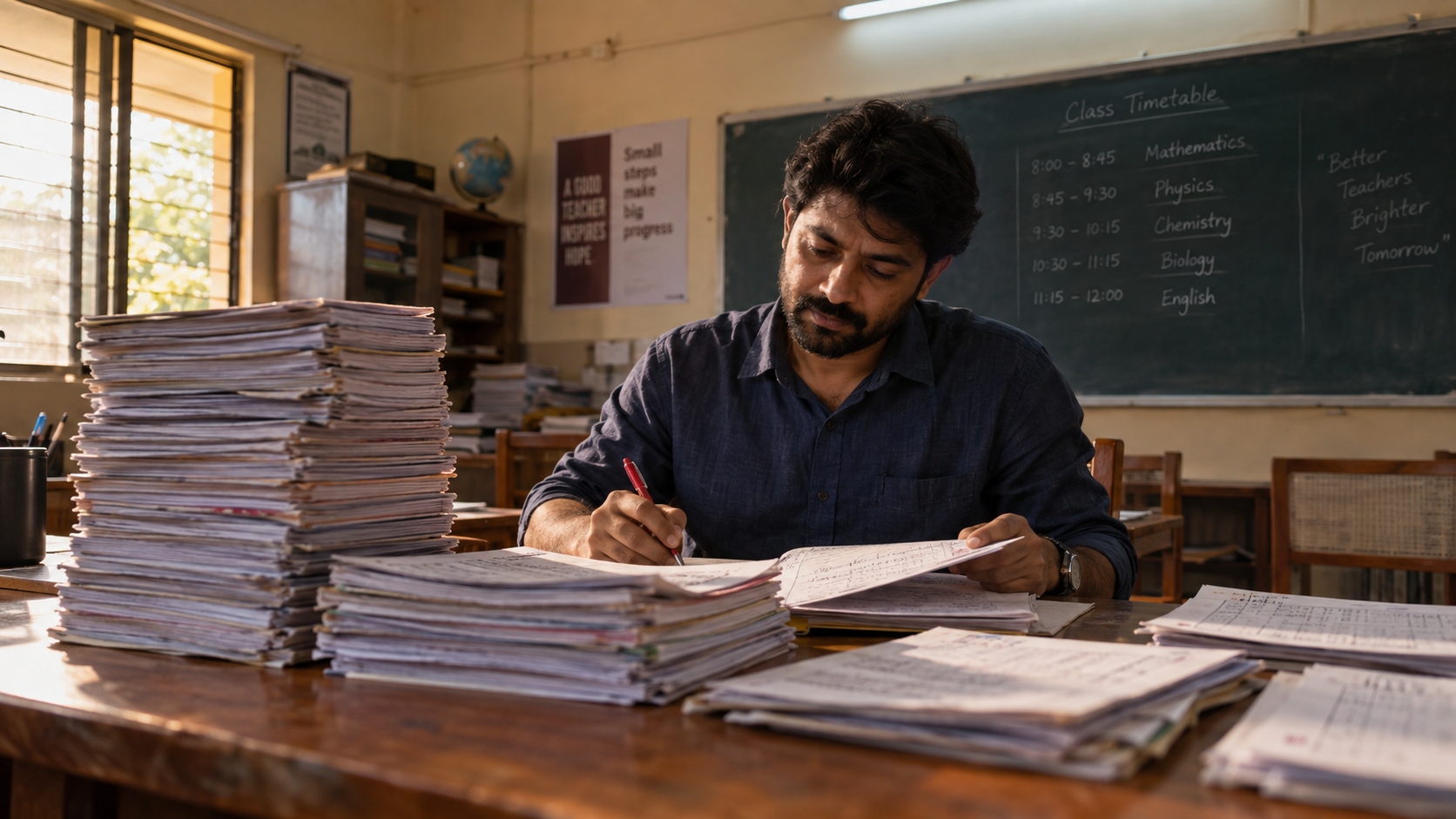
Run an internal orientation: how digital marking differs from physical evaluation and what discipline is expected in screen-based checking.
4) Set up a support loop for CBSE dry runs
-
Maintain a log: device issues, network drops, login problems, resolution time.
-
Escalate unresolved issues quickly once CBSE call centre and official instructions go live.
Why This Matters Beyond Boards: Internal Assessments Must Also Modernize
Even though CBSE's OSM applies to board evaluation, the expectation of digital, auditable, faster assessment cycles is clearly rising across schools. Institutions that modernize internal assessments early tend to see:
-
Faster feedback cycles for students
-
Better remediation planning for teachers
-
More structured reporting for leadership and parents
-
Lower teacher workload during peak exam periods
Modernizing School Assessments with Chanakya AI (Aligned With the OSM Shift)
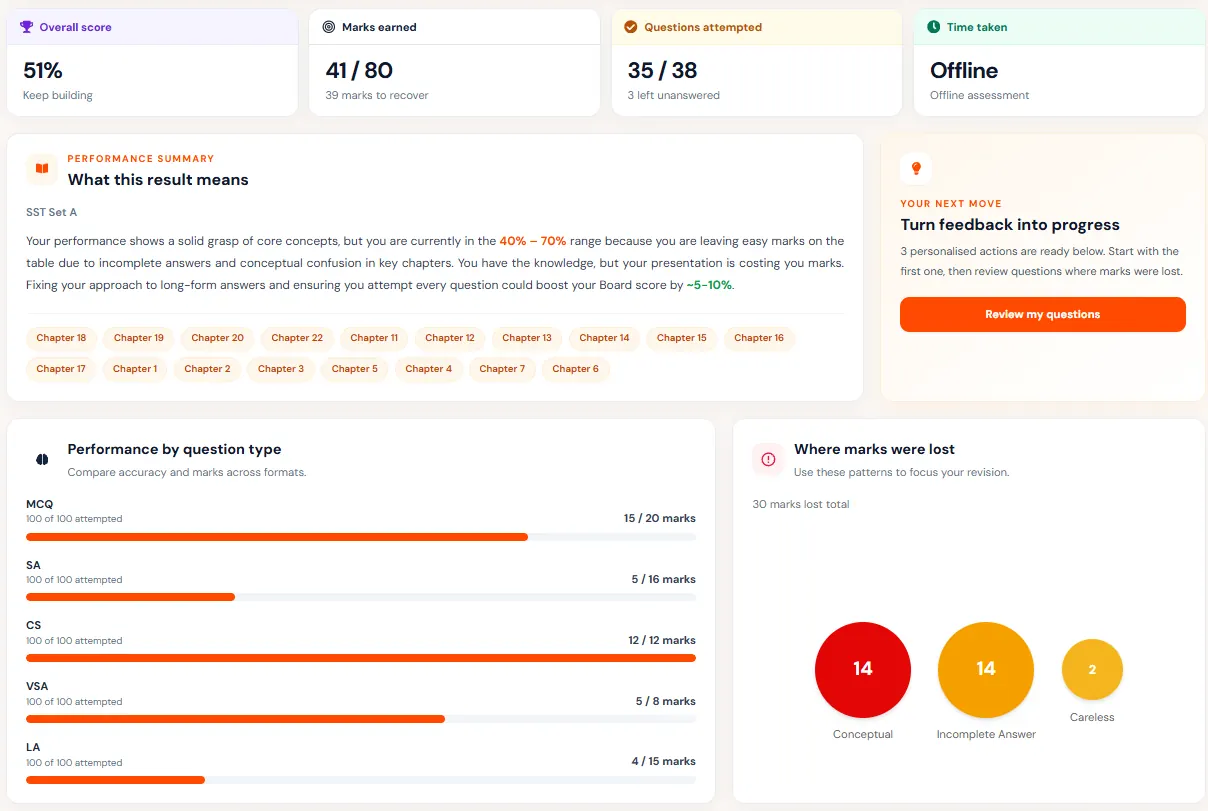
CBSE’s move to On-Screen Marking modernizes how final board answer books are evaluated. Schools can go one step further by modernizing internal assessments using AI-enabled checking and analysis, so students and teachers get benefits much earlier in the academic year.
With Chanakya AI, schools can:
-
Evaluate handwritten tests faster during routine worksheets, unit tests, preboards, and practice papers
-
Generate deeper analysis automatically, including question-wise marks, mark-loss reasons, topic-wise gaps, and common error patterns
-
Give students actionable feedback after every test, not only at the end of term
-
Help teachers plan remediation using batch-level insights, student groupings, and priority topic sequences
-
Track progress over time, so improvements can be measured across multiple assessments
This creates a practical advantage: while OSM improves board evaluation efficiency, AI-based checking improves day-to-day learning outcomes by shortening the feedback loop and improving targeted intervention.
Ready to modernize your assessment workflow?
-
Book a Demo: https://aichanakya.in
-
Email: [email protected]