The Crisis in One Minute
-
Indian universities do not lack assessments; they lack the capacity to turn every assessment into timely, actionable feedback.
-
A professor teaching 180 students can face 900 subjective responses from a single five-question test.
-
When feedback arrives weeks later, the class has moved on and students have little opportunity to correct their thinking.
-
AI can help convert answer sheets into learning signals, but faculty must remain responsible for verification and intervention.
-
The real opportunity is not faster grading alone. It is a shift from marks administration to assessment intelligence.
Assessment Is Happening Everywhere. Meaningful Feedback Is Not.
Walk into almost any university classroom in India and you will find no shortage of assessments.
There are assignments, internal examinations, quizzes, laboratory records, mid-semester tests, projects, practical examinations, and end-semester papers.
Students are being assessed constantly.
Yet there is an important difference between receiving a mark and receiving feedback.
A student who receives 12 out of 20 knows how they performed. They may still have no idea:
-
which concept they misunderstood,
-
where their reasoning broke down,
-
which part of their answer was incomplete,
-
whether the same mistake is appearing repeatedly, or
-
what they should revise before the next examination.
This is one of the least-discussed problems in Indian higher education.
Indian higher education does not have an assessment shortage. It has a feedback-at-scale problem.
The Mathematics of Faculty Workload
Consider a professor teaching three sections with 60 students each. That is 180 students.
Give those students just one five-question subjective assessment and the professor may already have 900 individual responses to evaluate.
Now add:
-
assignments,
-
internal assessments,
-
practical work,
-
projects,
-
remedial tests, and
-
semester examinations.
The problem becomes obvious.
Detailed, individual feedback is educationally valuable. At this volume, however, delivering it manually becomes operationally difficult.
As class sizes increase, faculty members are forced into trade-offs. They can conduct fewer assessments, provide shorter feedback, delay evaluation, or spend a significant share of their time checking work instead of teaching, mentoring, researching, and planning interventions.
None of these options is ideal.
Why Delayed Feedback Loses Its Value
Feedback has the greatest value while a student can still act on it.
Consider two scenarios.
Scenario A
A student takes a test on differential equations. Three weeks later, they receive:
14/20
The class has already moved to another topic.
Scenario B
The same student receives feedback shortly after the assessment:
14/20
Strong understanding of first-order differential equations.
Repeated error while applying integrating factors.
Revisit the transformation step before attempting advanced problems.
The mark is identical. The educational value is completely different.
The second assessment gives the student a next step. That is the real purpose of formative assessment: not simply to judge learning, but to improve the learning that follows.
Universities Are Also Losing Valuable Academic Data
There is another issue hidden inside the traditional assessment process.
Every answer written by a student contains information. It can reveal:
-
conceptual understanding,
-
misconceptions,
-
reasoning ability,
-
calculation errors,
-
application ability,
-
communication quality, and
-
common cohort-level weaknesses.
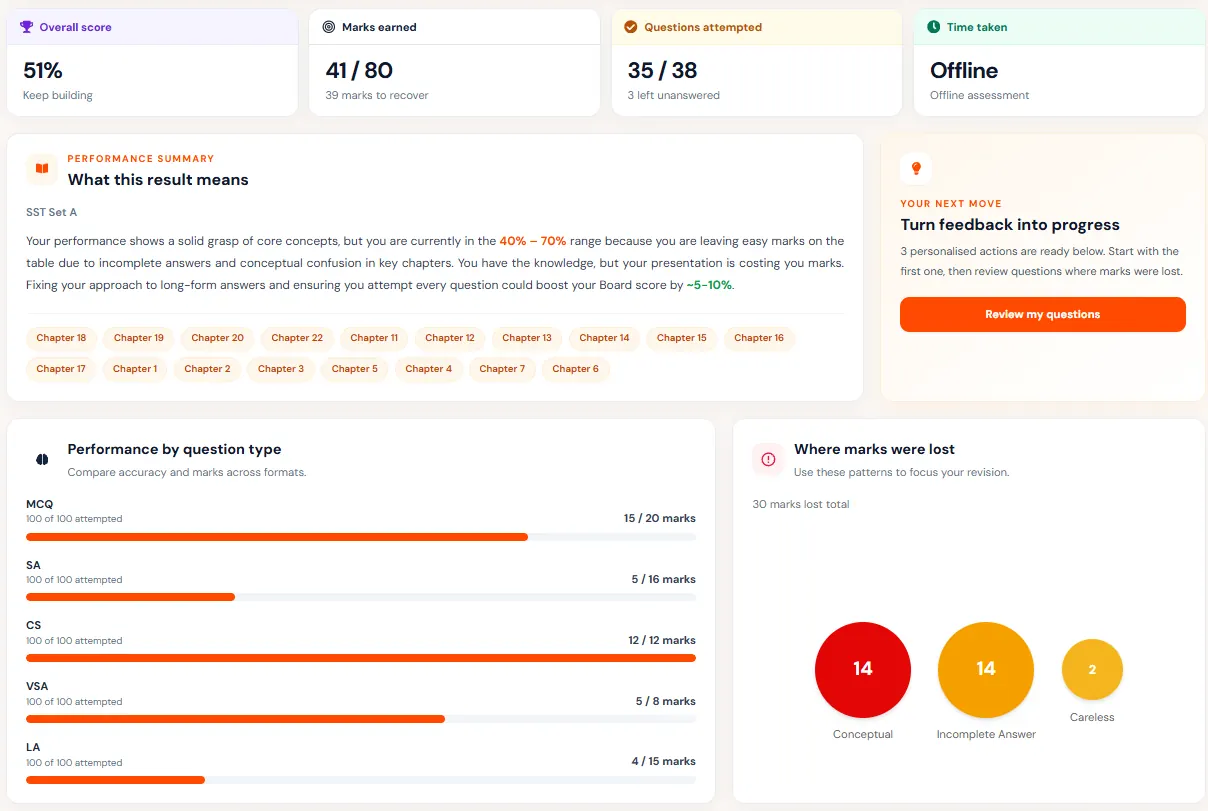
But after evaluation, much of this information gets compressed into a number: 72/100.
The university retains the score but often loses the underlying learning signal.
Across thousands of students and hundreds of courses, that represents an enormous amount of academic information that institutions could potentially use to improve teaching.
From Grading to Assessment Intelligence
This is where artificial intelligence can play a more meaningful role in higher education.
The opportunity is not simply to use AI to check papers faster.
A much more useful model is:
Assessment → Evaluation → Learning Signals → Intervention
Imagine that after an internal examination, a faculty member could see:
Course performance
- Average score: 68%
Strong concepts
-
Data structures
-
Basic algorithm analysis
Weak concepts
-
Recursion
-
Dynamic programming
Students requiring attention
- 17 students repeatedly struggling with recursive reasoning
Question insight
- Question 6 produced the highest error rate across all three sections
At that point, an examination is no longer just a mechanism for generating marks. It becomes a source of academic intelligence.
The Role of AI Should Be Assistance, Not Autonomy
Introducing AI into evaluation requires caution.
Universities should not treat AI as an unquestionable examiner. Subjective academic work contains nuance. Alternative reasoning may be valid. Rubrics may require interpretation. Handwriting may be ambiguous. Certain answers may need expert judgment.
A responsible model should therefore be:
-
AI evaluates.
-
Faculty verifies.
-
Analytics reveal patterns.
-
Faculty decides the intervention.
The professor remains academically responsible.
AI reduces repetitive work and helps surface information that would otherwise be extremely difficult to aggregate manually.
This distinction matters. The future of assessment should not remove educators from evaluation; it should give them better visibility and more time for the decisions only they can make.
Why This Matters Now
India's higher education policy is increasingly connecting education with skills, employability, technology, and measurable outcomes. In July 2026, the Ministry of Education highlighted greater industry-academic linkages and the government's Education-to-Employment and Enterprise initiative, including assessment of how emerging technologies such as AI are changing jobs and skill requirements.
The Bharat Bodhan AI Conclave 2026 also included AI for Higher Education as one of its priority areas and emphasized AI solutions with demonstrated outcomes rather than technology adoption for its own sake.
Universities do not need AI simply because it is trending. They need technology that solves real academic problems.
Feedback at scale is one of them.
What the Next Generation of Assessment Could Look Like
The university assessment workflow could gradually evolve from:
Conduct exam → Check answer sheets → Publish marks
to:
Conduct assessment → Evaluate responses → Identify concept-level weaknesses → Provide student feedback → Detect cohort-level patterns → Plan faculty intervention → Measure improvement
That is a fundamentally different approach to assessment.
Importantly, it does not require abandoning handwritten examinations or existing academic processes. Technology can sit on top of the assessment practices institutions already use.
A Practical Starting Point for Universities
Institutions do not need to transform every course at once. A focused, faculty-led pilot can establish value while protecting academic standards.
1. Start with a High-Volume Course
Choose a course with large sections, frequent subjective assessments, and a clear marking rubric. This makes both the workload problem and the potential time savings measurable.
2. Define the Human Review Boundary
Decide in advance which evaluations faculty will sample, which answers require mandatory review, and how students can request reconsideration. Academic accountability should be designed into the workflow from day one.
3. Measure More Than Speed
Track turnaround time, faculty effort, agreement with verified marks, feedback usefulness, recurring misconceptions identified, and whether students act on the guidance they receive.
4. Turn Patterns Into Intervention
The pilot succeeds only when the insights change what happens next: a remedial tutorial, a revised explanation, a targeted practice set, or an early conversation with a student who is falling behind.
Where Chanakya AI Fits
At Chanakya AI, we are building toward this idea of assessment intelligence.
Our assessment technology is designed to evaluate student responses, generate detailed feedback, identify topic-level learning gaps, and convert assessment data into actionable insights for educators.
The objective is not to replace academic judgment.
It is to help institutions move from simply knowing how much a student scored to understanding why they scored it and what should happen next.
The real value of an assessment should begin after the examination is over—not end with the mark.
Want to explore assessment intelligence for your institution? Talk to the Chanakya AI team.