As School Principals and Directors in the dynamic Indian education landscape, we wear many hats. We are administrators, mentors, strategists, and sometimes, crisis managers. We constantly strive for academic excellence and operational efficiency.
But there is a silent bottleneck in our schools. It’s an operational dinosaur that hasn't evolved in decades, and it’s draining the energy of our most valuable resource: our teachers.
I’m talking about the traditional, manual grading of answer sheets.
It’s exam season. Walk past your staff room past 4 PM. What do you see? Teachers hunched over piles of papers, red pens moving mechanically, calculating totals on calculators that have seen better days. They aren't planning inspiring lessons for tomorrow; they are acting as data entry clerks for yesterday's test.
The Sticker Shock: The 8-10 Hour Reality Check
We recently conducted informal surveys and time-motion studies across several mid-to-high-level schools in Indian metros. The results were startling, though perhaps not surprising to those of us on the ground.
During peak assessment periods (unit tests, mid-terms, pre-boards), an average subject teacher spends roughly 8 to 10 hours per week just grading papers.
Let's break down that number in the context of an Indian school:
-
High student-teacher ratios (often 40:1).
-
Teachers handling multiple sections across different grades.
-
The sheer volume of subjective answers demanded by boards like CBSE and ICSE.
That 10 hours isn't "found time." It’s taken from weekends, evenings, and time that should be spent on professional development or student mentorship.
The "Hidden Costs" Beyond the Clock
If it were just about time, we might accept it as "part of the job." But as school leaders, we must recognize the compound interest of this inefficiency. The cost isn't just hours; it's value.
1. The Burnout Epidemic
When a highly qualified educator spends their prime cognitive hours repeatedly checking the same definition of photosynthesis for the 150th time, decision fatigue sets in. This drudgery is a primary driver of teacher burnout in India. Tired teachers cannot inspire students.
2. The "Feedback Gap"
Manual grading is slow. By the time a student gets their paper back two weeks later, the context is lost. The learning moment has passed. Traditional grading provides a score, but rarely does it provide timely, actionable feedback.
3. The Insight Mirage
We collect marks, but do we collect data? Knowing Class X averaged 78% in Physics is okay. But knowing that 65% of Class X failed specifically on the concept of "Electromagnetic Induction" because they misunderstood the diagram—that is an actionable insight.
Manual grading buries these insights under mountains of paper. We cannot expect teachers to manually tabulate concept-wise errors for 200 students.
The Pivot: Embracing the New-Gen Assistant
We are living in 2024. Our students are digital natives. Our administrative operations are moving to the cloud. Why are we still grading like it’s 1994?
This is where we need to shift our perspective on Artificial Intelligence in education. AI is not here to replace the teacher; it is here to replace the drudgery.
Imagine a new-generation tool designed specifically for the rigorous demands of Indian schools—an AI-powered exam automation ecosystem that handles the heavy lifting.
Here is what the future of efficient school operation looks like:
-
Instant Grading, Subjective Included: AI models, trained on vast educational datasets, can now grade subjective answers with astonishing accuracy, adhering to your school's specific rubrics. What took a weekend now takes minutes.
-
The End of Calculation Errors: No more totaling mistakes. No more re-checking the re-checks. The system is foolproof.
-
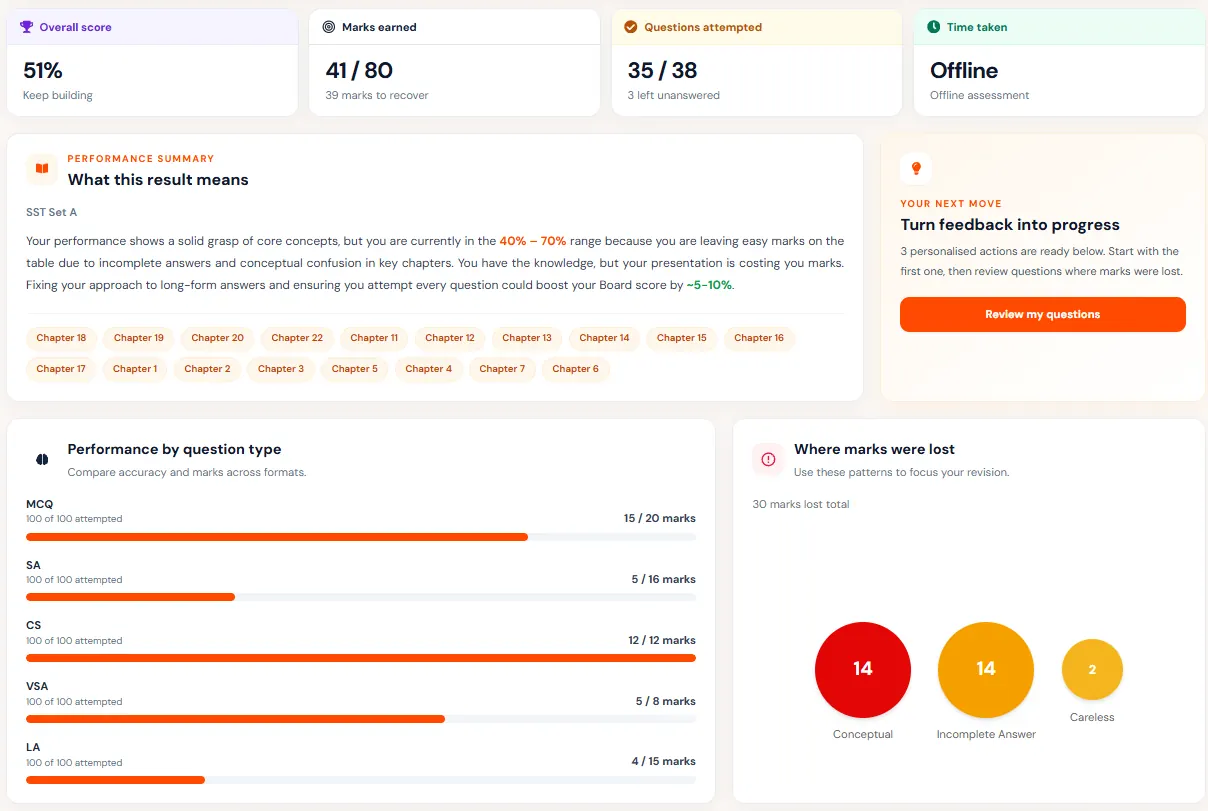
From Marks to Mastery Data: Instead of just a score sheet, the AI generates deep diagnostic reports. It identifies learning gaps at an individual and class level. It tells you why a student got a B, not just that they got a B.
The ROI: What Happens When You Give Back 10 Hours?
For a School Principal or Director, investing in AI exam automation isn't just buying software; it's an investment in human capital.
When you give a teacher back those 8-10 hours a week, the dynamics of your school change:
- Better Planning: That time goes into creating engaging, differentiated lesson plans.
- Personalized Mentorship: Teachers have the bandwidth to sit with struggling students and address the specific gaps identified by the AI insights.
- Improved Morale & Retention: Teachers feel valued as intellectuals, not clerical workers. Happy teachers stay longer.
- A Competitive Edge: Your school becomes known as a forward-thinking institution that uses cutting-edge technology to improve learning outcomes, not just for marketing brochures.
Conclusion: The Modern School Leader's Choice
The traditional red pen has served its time. But holding onto it is now actively holding our schools back.
Moving to AI-assisted grading is no longer a futuristic luxury; it’s an operational necessity for schools aiming for scalability and excellence. It’s time to liberate our teachers from the paper mountain and let them get back to what they do best—teaching.
Are you ready to reclaim those lost hours and unlock deep operational efficiency in your school? The future of grading is automated, insightful, and human-centric.
Stop Grading, Start Teaching.
Discover how our AI-powered Exam Automation platform can save your school hundreds of teacher-hours this term.