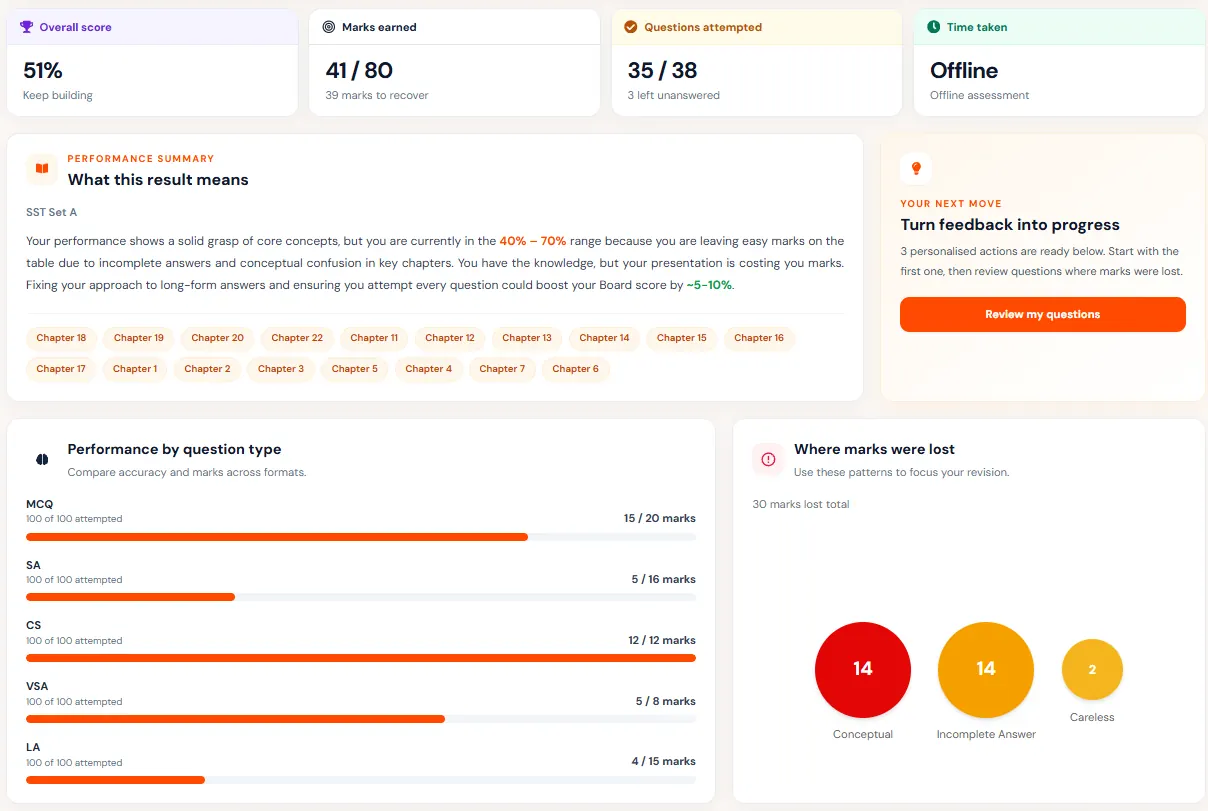
If you have ever had a few hundred answer sheets waiting on your desk after an exam, you already know that conducting the test is often the easy part.
The real work starts afterward.
A teacher has to read every answer, understand what the student was trying to do, decide how many marks it deserves, write feedback, total the scores and eventually figure out what the class actually got wrong.
And when the answers are handwritten, subjective and sometimes several pages long, that work becomes even harder.
This is where AI answer sheet evaluation comes in.
But there is an important misconception about it:
AI grading is not simply about finding the correct answer.
A good evaluation system needs to understand the student's work, the question being asked, the marking criteria and the reasoning behind the answer.
Sometimes the final answer is wrong even though most of the work is correct. Sometimes two students arrive at the correct answer using completely different methods. Sometimes a student gets only one part of a four-part question right.
A useful AI evaluator needs to understand those differences.
What is AI answer sheet evaluation?
AI answer sheet evaluation is the use of artificial intelligence to read student answer sheets, understand their responses and evaluate them against a question's expected answer or marking rubric.
For handwritten assessments, this can involve several stages:
Student writes the answer → the paper is scanned or photographed → the system reads the handwriting → identifies the questions and responses → understands the student's work → applies the marking criteria → assigns marks and feedback.
The technology behind this can involve handwriting recognition, document understanding, vision models and AI-based evaluation.
But the important part isn't the individual technology.
It is how all of these pieces work together to evaluate the student's actual work.
The answer doesn't always tell the whole story
Consider a simple mathematics example.
Suppose a four-mark question asks a student to calculate a matrix expression.
A student correctly calculates the first matrix operation and gets the next intermediate calculation right. But then they make a mistake in one multiplication and use the wrong sign when calculating the final answer.
The final answer is wrong.
Should the student get zero?
Probably not.
If the marking scheme awards marks for the intermediate steps, the student has demonstrated that they understood a significant part of the problem.
In one Chanakya evaluation, the student received 2 out of 4 marks.
The AI identified that the student had correctly calculated the intermediate matrices but had failed to multiply one term by 3 and had added it instead of subtracting it.
The important thing here isn't that AI got the final answer right or wrong.
It is that the system was able to identify where the student's work was correct and where it went wrong.
That is the difference between answer matching and answer evaluation.
Three students can answer the same question differently—and all deserve marks
This becomes even clearer with a multi-part question.
Imagine a coordinate-geometry question worth four marks:
- Find the midpoint.
- Calculate the length of the median.
- Find the equation of the median.
- Calculate the centroid.
Now imagine three students:
| Student | What they got right | Marks |
|---|---|---|
| A | Centroid only | 1/4 |
| B | Midpoint, median length and centroid | 3/4 |
| C | Midpoint, median length and equation of median | 3/4 |
Students B and C have not given the same answer.
In fact, they have got different parts of the question right.
But both deserve 3/4.
This is one of the most important things an AI evaluator has to understand.
It should not simply compare a student's answer with one "perfect answer" and decide whether the two are similar.
It needs to understand what the question is testing and which parts of the student's response satisfy those requirements.
That is where rubrics become important.
So how does AI actually evaluate a handwritten answer sheet?
The exact technology can vary between systems, and it is not necessary for an educator to understand every model or component involved.
At a high level, however, a good evaluation workflow has to solve several different problems.
1. First, the system needs to understand the paper
The input is usually a scanned answer sheet or a photograph of the student's work.
The system needs to understand things such as:
- Where the student's writing is
- Which question the student is answering
- Where one answer ends and another begins
- Whether there are multiple pages
- Whether something has been crossed out
- Whether the student has continued an answer elsewhere
- Whether a diagram or calculation is part of the response
This sounds simple until you look at a real answer sheet.
Students don't always follow the neat structure we would like them to.
They may skip questions, return to an earlier question, write an answer on another page, cross something out, draw diagrams or attempt the same question more than once.
Real answer sheets are messy.
A useful evaluation system has to deal with that reality.
2. The system needs to read handwriting
Typed text is relatively straightforward for software to process.
Handwriting is different.
Letters can be unclear. Words can overlap. Students can write quickly, use unusual handwriting styles or place text in unexpected locations.
This is where handwriting recognition or ICR (Intelligent Character Recognition) can play a role.
But simply converting handwriting into text isn't enough.
Imagine a mathematics answer containing:
x = 2
followed by a crossed-out calculation and then:
x = 3
A system needs to understand which work is actually the student's final attempt.
That is why answer-sheet evaluation is more complicated than simply running handwriting through a text-recognition system.
3. The system needs to understand the question
Before evaluating an answer, the system needs to know what the student was actually asked.
For example:
Explain three causes of the French Revolution.
is very different from:
Describe the economic causes of the French Revolution and explain their impact.
The marking criteria are different.
Similarly, a mathematics question may award marks for:
- identifying the correct formula,
- substituting the correct values,
- showing the calculation,
- reaching the correct result.
The AI needs to understand that structure before it can meaningfully evaluate the student's response.
4. The system needs a marking rubric
This is where the evaluation becomes much more than "Does the answer look correct?"
A rubric tells the evaluator what should receive marks.
For example:
| Step | Marks |
|---|---|
| Correct formula | 1 |
| Correct substitution | 1 |
| Correct calculation | 1 |
| Correct final answer | 1 |
Now imagine a student gets the formula, substitution and calculation right but makes a small arithmetic error at the end.
A good evaluation should be able to recognise that the student's understanding is different from simply "wrong answer."
Rubrics also make it possible to award partial marks consistently.
What about students who use a different method?
This is one of the biggest questions teachers have about AI grading.
And rightly so.
A student doesn't always solve a problem exactly the way the teacher did.
For example, a mathematics teacher may demonstrate Method A in class.
A student might use Method B.
If Method B is mathematically valid, the student should not lose marks simply because it isn't the model solution.
This is why evaluating subjective answers requires more than keyword matching.
The evaluator needs to understand the reasoning and concepts demonstrated by the student's response and compare those with the marking criteria.
In other words:
The model answer is a reference. It should not become a cage.
Can AI award partial marks?
Yes—and this is one of the most useful applications of AI evaluation.
Consider a five-mark science question.
A student might:
- identify the correct concept,
- explain two of the three required points,
- make one factual error,
- and leave the final conclusion incomplete.
Giving the student either 0 or 5 marks would not accurately represent their work.
A rubric-based evaluation can instead break the question into the relevant components and award marks for the parts that were demonstrated correctly.
This is particularly important for mathematics, physics, chemistry, engineering and other subjects where the steps themselves often matter.
What about diagrams?
Diagrams introduce another layer of complexity.
A student may answer a question using:
- a labelled diagram,
- a graph,
- a circuit,
- a geometry construction,
- a chemical structure,
- a flowchart,
- or another visual representation.
A system evaluating these answers needs to understand more than text.
It needs to interpret what the student has drawn, understand relevant labels and features, and evaluate the drawing in the context of the question.
This is one reason modern AI evaluation is moving beyond traditional OCR-only approaches toward systems that can understand both text and visual information.
Recent research into handwritten AI grading has specifically tested questions involving drawings, graphs, numerical work and open-ended responses—and found that different types of answers can have very different reliability.
So when someone says:
"AI can read handwriting, therefore AI can grade the exam."
there is a missing step.
Reading the answer is only the beginning.
Does AI always get grading right?
No.
And we think this is an important point to say clearly.
AI systems can make mistakes.
A grading system can encounter problems because of:
- unclear handwriting,
- poor-quality scans,
- incorrectly mapped questions,
- multiple attempts at the same question,
- crossed-out answers,
- ambiguous questions,
- unusual but valid solution methods,
- diagrams,
- complicated mathematical notation,
- or an incomplete marking rubric.
Even academic research on handwritten AI grading has found that performance varies by question type and that human oversight remains important, particularly for more difficult or ambiguous responses.
So the right question isn't:
"Can AI grade an answer sheet perfectly?"
The better question is:
"How can AI handle the large majority of routine evaluation while making uncertainty and difficult cases easier for teachers to review?"
That is a much more useful way to think about AI in assessment.
AI grading should assist teachers, not pretend teachers don't matter
Teachers understand context that a machine may not.
They know their students.
They know how a particular class was taught.
They can recognise when a question was ambiguous.
They can decide when an unusual answer deserves a second look.
AI can take over a large amount of repetitive work, but academic judgement still matters.
The best systems should therefore give educators visibility and control, rather than hiding the evaluation behind a single number.
The broader research direction is increasingly consistent with this approach: AI can assist with routine grading, while human review remains important for uncertain or higher-risk cases.
The real challenge isn't just the AI model
This is something we have learned while building Chanakya.
It is tempting to think that building an AI evaluator means choosing a powerful model and asking it:
"Give this student a mark."
It isn't that simple.
The quality of evaluation can depend on the entire assessment workflow.
For example:
Was the question paper understood correctly?
Were the questions mapped to the right answers?
Did the student attempt the question more than once?
Was the crossed-out work actually meant to be ignored?
Was the marking rubric clear?
Did the student use an alternative but valid method?
Was the handwriting readable?
Was a diagram part of the answer?
Did the system understand the difference between an MCQ option and handwritten working?
These details can have a surprisingly large impact on the final evaluation.
That is why we believe AI answer-sheet evaluation is an assessment workflow problem, not simply an AI model problem.
What should you look for in an AI answer-sheet evaluation system?
If you are a teacher, principal, academic head or coaching director considering AI evaluation, don't stop at:
"How accurate is your AI?"
Ask a few more questions.
1. Can it evaluate actual handwritten answers?
Not just typed responses or multiple-choice questions.
2. Can it award partial marks?
A student shouldn't automatically receive zero because the final answer is wrong.
3. Can it understand different valid approaches?
A correct solution shouldn't be penalised simply because it doesn't match the model answer word-for-word.
4. Can it evaluate the steps?
This is particularly important in mathematics, physics, chemistry and engineering.
5. Can it understand diagrams?
Ask how the system handles graphs, labelled diagrams, constructions and other visual answers.
6. Can a teacher understand why marks were awarded?
A mark without an explanation is much less useful than a mark accompanied by a clear reason.
7. What happens when the AI is uncertain?
This may be one of the most important questions of all.
A good system should have a way to identify difficult cases rather than confidently pretending every answer is straightforward.
8. Can it handle real answer sheets?
Ask about messy handwriting, multiple pages, crossed-out work, skipped questions and students who don't follow the expected format.
Because that's what teachers actually deal with.
How Chanakya approaches answer-sheet evaluation
At Chanakya, we started with a simple observation:
Teachers don't just check whether the final answer is correct. They evaluate the work that led to it.
Our evaluation system is designed around that principle.
Chanakya reads the student's response, understands the question and evaluates the work against the relevant marking criteria. This allows it to award credit for correct steps, recognise partial answers and provide reasoning behind the marks.
It can also understand visual information in answer sheets, including diagrams, their labels and what the student has drawn, rather than treating the paper as a block of text.
Today, Chanakya is being used across subjects including mathematics, physics, science, social science, engineering and other English-medium assessments. We are also testing Hindi evaluation as we expand language support.
More than 100,000 answer sheets have been processed through Chanakya's systems so far.
But we don't think that number means the problem is "solved."
In fact, processing real answer sheets has taught us the opposite.
The more real papers you see, the more edge cases you discover.
And that is exactly why we continue to focus on the complete evaluation workflow—not just the AI model sitting somewhere in the middle of it.
The future of answer-sheet evaluation isn't "AI instead of teachers"
It is more likely to be:
Teachers + AI.
AI handles the repetitive parts:
- reading large volumes of answers,
- organising responses,
- applying consistent criteria,
- suggesting marks,
- generating feedback,
- and identifying patterns across large numbers of students.
Teachers spend more of their time on the parts that require judgement:
- reviewing difficult answers,
- understanding student misconceptions,
- improving teaching,
- discussing results,
- and helping students improve.
The goal isn't to remove the teacher from assessment.
The goal is to give the teacher their time back.
Frequently asked questions
Final thought
The most useful way to think about AI answer-sheet evaluation is not:
"Can AI replace a teacher who checks papers?"
It is:
"How much of the repetitive work can AI handle while still respecting the way teachers actually evaluate student thinking?"
That is the problem worth solving.
And it is a much harder problem than simply finding the right answer.