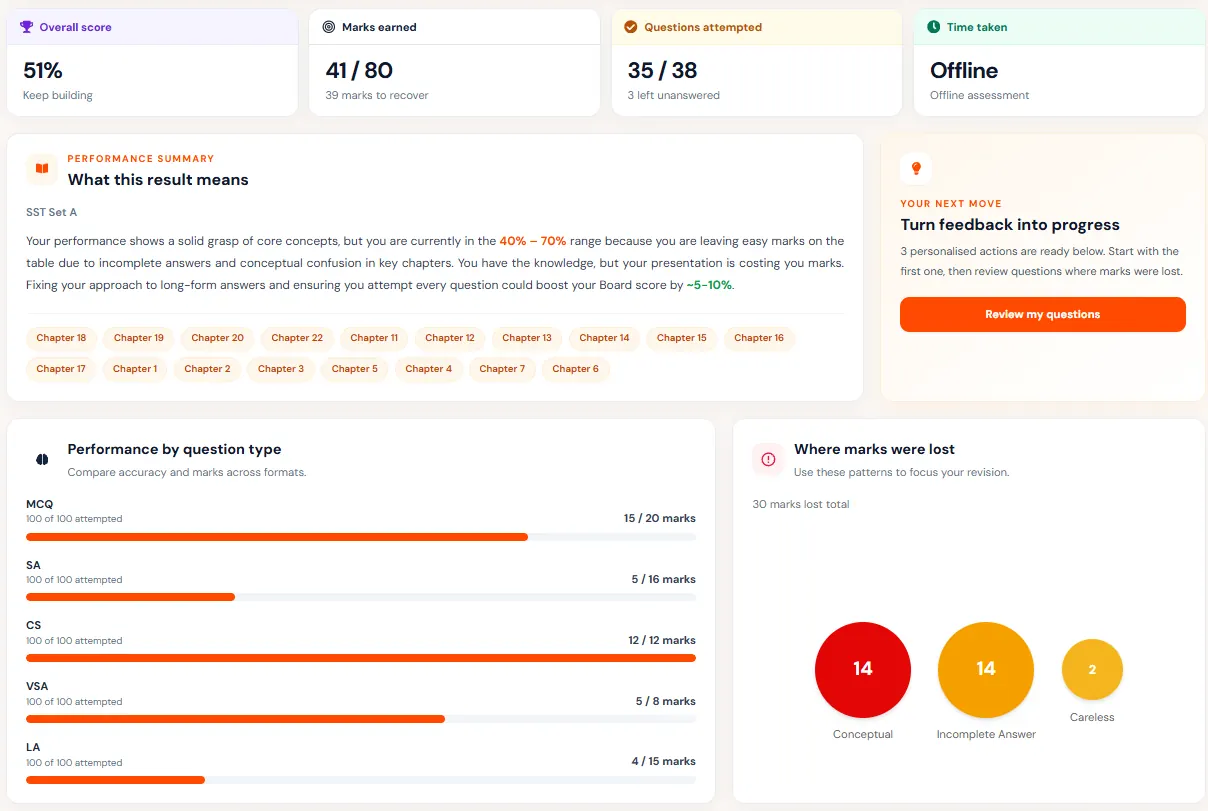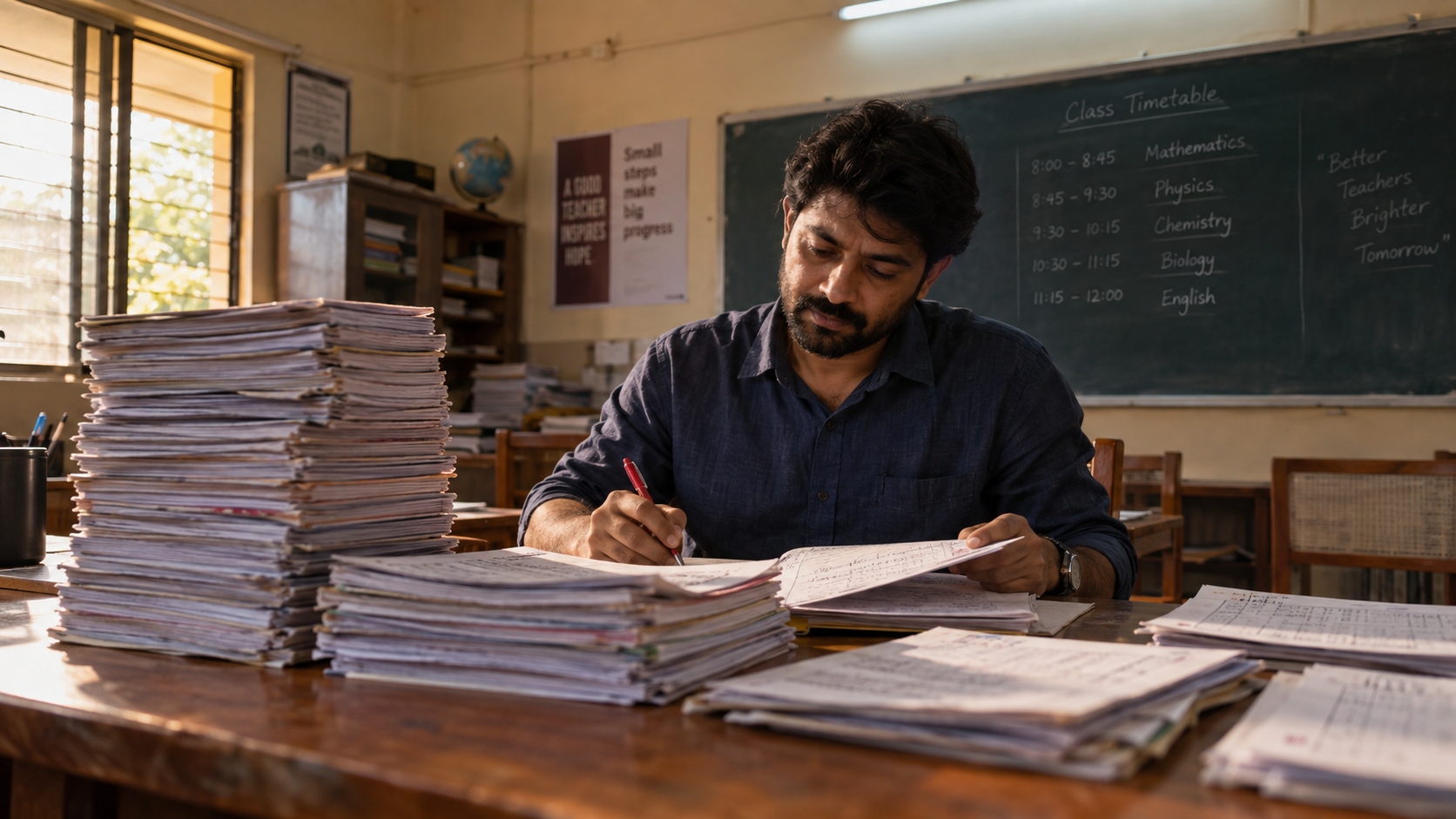
A coaching institute can finish a weekly test in an hour. The harder part is still sitting on the table when the next batch walks in.
Papers from Monday are not fully checked. Tuesday’s test is already on the timetable. By the time marks come back, the class has moved to the next chapter. The test happened. The learning from it did not.
People often treat this as a teacher problem. It isn’t. Teachers can check papers. They have always been able to. What they cannot do is make the week longer. When you run board exam practice across several batches, the volume grows every week. Teacher time does not.
Weekly tests don’t fail because teachers can’t check. They fail because the pile never stops.
That is what AI answer sheet checking is for. Not replacing the examiner. Getting checking done in time for the next class to still use the result.
At Chanakya, once answer sheets are uploaded, evaluation is typically back within a few hours. That is early enough for a weekly cycle: before the next class on that chapter, not after the institute has already moved on.
How those marks are awarded (partial credit, working, different valid methods) is a separate question. We wrote about that in how AI checks handwritten answer sheets. This article is about the week around the test: turnaround, consistency across batches, and what the teacher still reviews.
The test is the easy part of the week
Board coaching lives on repetition: weekly tests, chapter tests, mock exams, revision papers that look like the board. Students join because the institute tests often enough for mistakes to show up while there is still time to fix them. The calendar assumes checking will keep up. It often does not.
A single paper is not the problem. The problem is the same paper, written by several batches, in more than one subject, week after week. The stack from the last test is still open when the next one is printed.
So the institute usually does one of three things. It delays results until they are mostly a rank list. It asks teachers to check late into the night and hopes the marking stays even. Or it tests less often than the academic plan says it should. None of those is a teaching strategy. They are what happens when checking cannot keep up.
Turnaround is a teaching problem
“Fast checking” is easy to advertise and easy to misunderstand. For a weekly board exam test, fast enough is not a software slogan. It is a classroom fact: the student should see the marks while that chapter is still the chapter.
If feedback arrives after the batch has started the next topic, the paper still produces a score. It does not produce a useful revision hour. The teacher cannot reteach what the test just showed. The student cannot sit with the exact question they lost marks on.
Two timings matter. Once the sheets are uploaded, checking is typically done within a few hours. That only helps if the results are with the teacher before the next class on that portion.
A mock exam can sometimes wait a little longer. A Thursday weekly test cannot. If Friday’s class is already on the next chapter, the pile did not just create extra work. It wasted the test.
Consistency across batches is the other problem
Even when teachers finish the pile, another issue shows up. The same question paper is often written by Batch A on Monday and Batch B on Wednesday. Different teachers may check them. The same teacher may check them on different evenings, after different amounts of tiredness.
An academic head then looks at the marks and cannot tell a simple thing apart: is this gap the student, or the checker?
Weekly tests are supposed to be comparable. That is their point. You want to know whether this batch is weaker on a chapter, whether last week’s revision worked, whether one centre is drifting. If the marking scheme is applied more generously on Tuesday than on Thursday, the numbers mislead you. Nobody meant it to happen. Volume makes it normal.
Teachers are not careless. A shared marking scheme still needs a shared checking process, especially when the same paper runs across batches.
AI checking helps here because it applies the institute’s criteria to every sheet in the upload. Teachers still review what needs a human look. They are not each reinventing the scheme at 11 p.m.
What AI should check, and what the examiner still owns
A useful split is not “AI hints, teacher grades.”
The system should check the answer sheets. Marks, reasons for deductions, totals for each question: that work should be done. Teachers should not have to reread every page to find out what the student scored.
What teachers still own is academic control.
| Chanakya checks | The examiner still owns |
|---|---|
| The uploaded handwritten sheets, in bulk | Whether this marking scheme matches how the batch was taught |
| Marks against the institute’s scheme | Changing a mark when the work deserves a different reading |
| Reasons for deductions, question by question | What to reteach in the next class |
| The same criteria on every batch that wrote the paper | What to do when a question was ambiguous |
| Scripts that need a human look, flagged for review | Which results go out to students |
If a system only “suggests” marks and the teacher still has to rebuild the evaluation, you have not removed the pile. You have added a screen to it.
If a system checks everything and nobody can change a mark, you have removed the examiner. That is the wrong trade for a coaching institute.
The version institutes can actually run every week is simpler. Chanakya checks the papers. Teachers review the ones that need them.
Only the flagged sheets should go back to the teacher

Once checking is done, the teacher’s job is not to start from page one again. The useful review queue is smaller: sheets the system flags (unclear handwriting, incomplete work, missing pages, answers that need a second look). If the academic head wants extra comfort in the first week, a small sample from the rest is fine.
The rule for a normal week should be the first of those. Review the flagged answer sheets. Do not recheck the whole batch as a habit.
That is how teacher time stays on judgement instead of volume. Exceptions get a person. The rest of the evaluation is already done, with marks and reasons the teacher can open if a student questions a score.
Institutes that are new to this often sample a few unflagged papers in the first week, to see how the scheme is being applied. That is reasonable. It should not become the weekly routine. If every script is reread, the pile has only changed shape.
A weekly rhythm that does not depend on one exhausted checker
The workflow is not complicated. It fails when any step waits for a person who is already teaching.
1. Lock the paper and the marking scheme before the test. The same scheme should apply to every batch that writes that paper. If the scheme is still being debated after the test, checking will wait, with or without AI.
2. Students write as they already do. Handwritten weekly tests and mocks. You do not need to turn board practice into an on screen exam.
3. Scan the sheets with a phone or a scanner, and upload them.
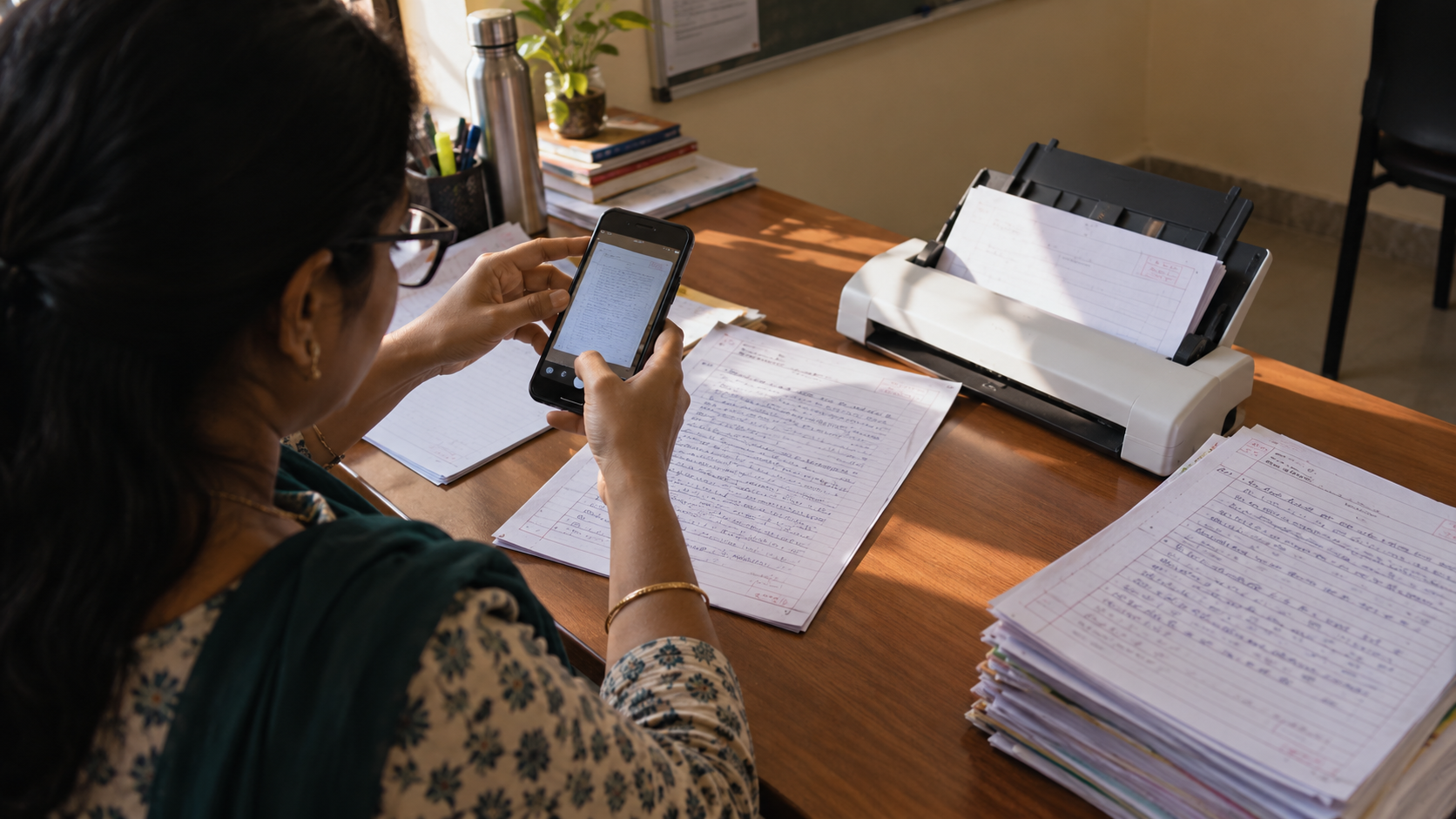
Photographs or scans are enough if pages are readable, complete, upright and in order. The institute uploads them to the platform.
4. Chanakya checks the batch. Evaluation is typically back within a few hours of upload: marks, reasons, question by question.
5. Teachers review what is flagged. Change a mark where the work needs it. Leave the rest.
6. Use the result in the next class on that chapter. Not two tests later.
If this loop closes, the next weekly test can happen without last week’s papers still sitting in a cupboard. If it does not close, adding more tests only grows the pile.
A practical way to start is the same as a coaching pilot: one familiar test, one batch, your question paper and marking scheme, your answer sheets. See the evaluation with your teachers before you put the whole timetable on it.
What this will not do for you
Checking within a few hours still depends on what you upload. Poor photographs, missing pages, sheets that arrive two days late, or a marking scheme that was never written down will delay the week. The software cannot invent a page that was not scanned.
Teachers also do not disappear from the process. Flagged review is still work. It is a different kind of work: fewer papers, more judgement.
And a Thursday weekly test is not the same as a board final. Public examinations have their own rules and oversight. This article is about the tests a coaching institute runs in order to teach, the ones that have to come back before the next class.
If you want the evaluation questions in more depth (handwriting, partial marks, diagrams, where AI still struggles), they are in the handwritten evaluation article. The short version is the same one we use everywhere else: AI can get things wrong. That is why flagged review exists.
What a coaching director should ask before buying
Do not start with a demo PDF that never looked like your mock. Ask how the week would actually run.
Once our sheets are uploaded, how soon is the batch checked? You need an answer in hours, not “faster than manual,” if the next class is tomorrow.
Do we get the evaluation, or a hint the teacher still has to rebuild? Marks and reasons should be there. Review should be needed where a script is flagged, not for every page.
What gets flagged, and who reviews it? If everything is flagged, you are back to the pile. If nothing is flagged, you have no control.
Will Batch A and Batch B be checked against the same scheme? If the vendor cannot show you that, weekly tests will not be comparable.
Can a teacher change a mark and see why it was given in the first place? Students will ask. Parents will ask. The academic head will ask.
Can we start with one real test we already know? Your paper, your sheets, your teachers’ judgement next to the evaluation.
Those questions are more useful than another accuracy percentage. They describe the problem you actually have.
How Chanakya runs this for coaching institutes
Chanakya is a tool for examiners to check answer sheets at scale, with consistency.
You upload scanned or photographed sheets. The system evaluates them against your marking criteria, including credit for correct work, not only the final line. You get the checked batch back, typically within a few hours. Teachers review the scripts that are flagged.
We have processed 1.5 lakh+ exams and checked 12 lakh+ subjective answers. That number does not mean weekly tests are an easy problem. It means the problem is volume, and volume is what the workflow has to survive.
The goal is not to take the teacher out of assessment. The goal is to stop making the teacher the reason the next test cannot happen.