The weekly test is checked. The marks are in. The academic head still has the same problem as before, only faster: a list of scores, and a class tomorrow.
41 out of 80. 52. 68. 29.
You can rank the batch with that. You cannot decide the next hour with it.
Same student. Fourteen marks lost to concepts, fourteen to incomplete answers, two to carelessness. Those are different Friday classes.
This is the piece that follows checking weekly tests without making teachers the bottleneck. That article is about getting papers back before the next class. This one is about what an owner or academic head should actually do once they are back.
How those marks were awarded, including partial credit, is in how AI checks handwritten answer sheets. We will not retell that here.
A score tells you what happened
Board coaching runs on weekly tests because a number is supposed to change the week. The student who scored 41 should leave the next class knowing what to fix. The teacher should know whether to reteach a chapter, insist on complete answers, or leave that child alone on “silly mistakes.”
A total does none of that.
41 out of 80 only says the student is somewhere in the middle of the batch. It does not say whether the paper was mostly MCQs they could guess, long answers they never finished, or a chapter they have not understood. Two students with 41 can need opposite work.
If all you publish is the score, the test produced a rank list. The revision hour will be a guess.
Look at one paper, not the average
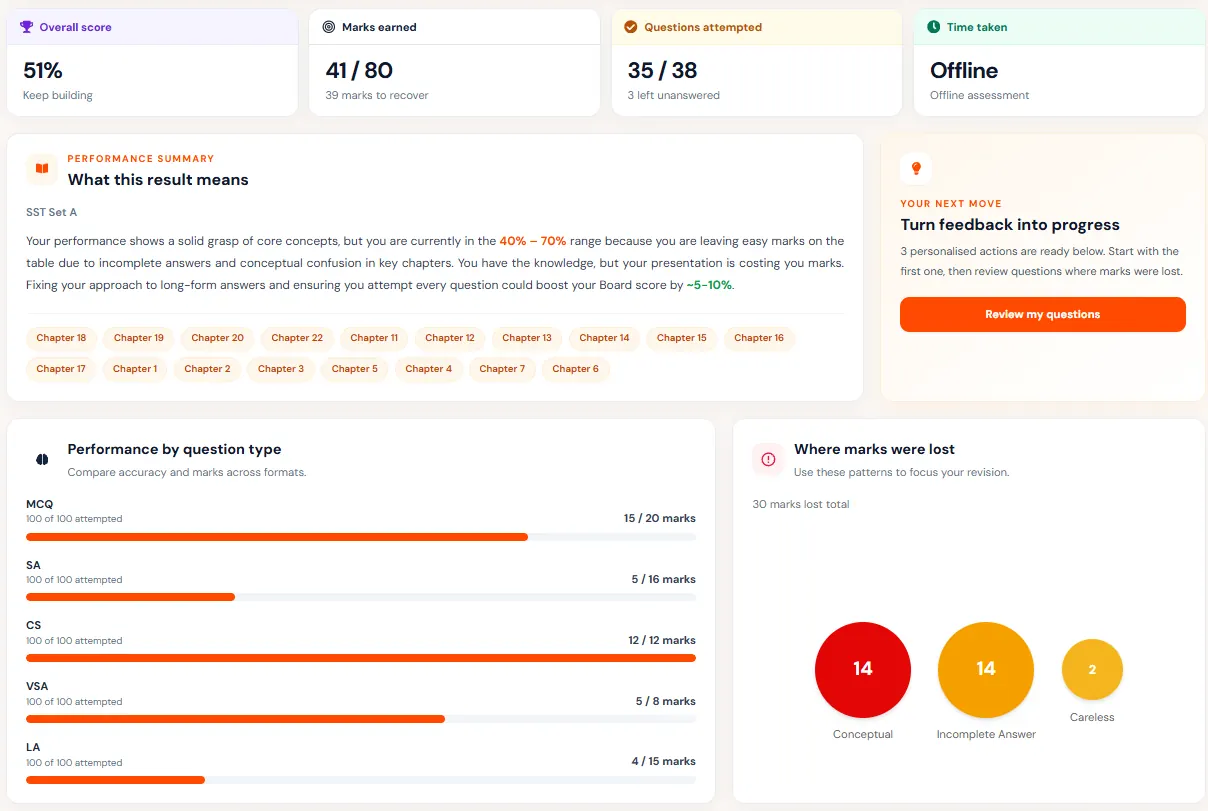
Here is a real weekly test style report, identifiers removed. SST, Set A. Offline. 41 out of 80. Thirty-five questions attempted out of thirty-eight.
That already changes the story. This is not a student who gave up. Three questions were left. The rest of the paper was tried.
By question type:
| Type | Marks |
|---|---|
| MCQ | 15 / 20 |
| Short answer | 5 / 16 |
| Case study | 12 / 12 |
| Very short answer | 5 / 8 |
| Long answer | 4 / 15 |
The case study is full marks. The MCQs are fine. The hole is short and long writing: 9 marks from 31 on those two types.
If you only saw 41, you might send this student to “work harder” or “revise SST.” The paper is more specific. They can handle a case. They are losing the marks that sit in written answers.
The 30 marks they did not get are not one problem
The report splits where marks were lost: conceptual 14, incomplete answer 14, careless 2.
Those are not three ways of saying “weak student.” They are three jobs.
Conceptual 14. Something in the chapter is not clear. Another lecture on the same page, a worked example, a short retest on that idea. Practice papers will not fix this if the idea is wrong in their head.
Incomplete 14. They started the answer and stopped, or they never wrote the second part the scheme was paying for. That is presentation and completeness, not “they don’t know SST.” The next class is: finish the question, hit every heading, use the marks in the margin as a checklist.
Careless 2. Almost nothing. Nagging the batch about silly mistakes would waste the hour this student actually needs.
An owner who only sees 41 will often pick the wrong Friday. They will run extra MCQ drills because the score looks “middling,” or they will talk about carelessness because that is the easy story. This paper does not support either.
Fourteen and fourteen and two is the useful sentence. 41 is the headline.
What you should ask after every weekly test
For that student:
- Did they attempt the paper?
- Which question types held, and which collapsed?
- Of the lost marks, how many were concept, incomplete, or careless?
- What should tomorrow’s work be: reteach, complete answers, or leave it?
You do not need a dashboard speech to ask those. You need the evaluation broken down, not only totalled.
Then look at the batch the same way, without pretending one child’s 41 is the class.
- Which questions did most of the room lose?
- Is that the same chapter, or the same habit (incomplete written answers, for example)?
- Are two batches that wrote the same paper losing marks in the same place, or is one centre teaching it differently?
If Batch A is incomplete on long answers and Batch B is conceptual on the same chapter, they do not need the same revision worksheet. A single average for the test will hide that.
We are not going to invent a class percentage to make this sound scientific. The point is the questions. If you cannot answer them from the test you just ran, the checking was only a score.
What this will not do
It will not replace the teacher who knows how this batch was taught. A category on a report is a starting point. If the academic head thinks the “incomplete” pile is actually a badly worded question, that judgement wins.
It will not help if the marking scheme was never written down. Categories are only as honest as the scheme.
It is not university CGPA analytics, and it is not a promise about board percentages. It is one weekly paper, read closely enough that the next class has a job.
And it is useless if the marks arrive after you have moved chapter. That is why checking turnaround belongs with this, not instead of it.
How Chanakya shows this
Chanakya checks the sheets against your scheme, then you can see the total and the breakdown: question types, and where marks were lost.
We have processed 1.5 lakh+ exams and checked 12 lakh+ subjective answers. Volume is not the same as understanding a 41. The 41 is useful when a teacher can see the 14, the 14, and the 2.
Start the same way as the coaching pilot: one batch, one test you already know, your paper and your sheets. Look at a few students the way we looked at this one. If the next class is obvious from the report, the test did its job.