Key Takeaways for Principals
-
Visibility Gap: Traditional manual grading leaves principals blind to learning gaps for 3–5 days after every exam.
-
Real-Time Data: AI assessment gives you instant feedback and class-level learning trends, enabling Monday morning interventions.
-
Clear ROI: Schools save hundreds of teacher hours every month and see measurable impact, including up to 18% reduction in learning lag.
-
NEP 2020 Aligned: Automated tools are the only scalable way to run continuous, competency-based assessment without overloading staff.
-
Easy Adoption: Modern AI handles messy handwriting with ~95% accuracy and can be rolled out with minimal teacher training.
The Monday Morning Question Every Principal Should Ask
Imagine walking into your school on a Monday morning. As you greet students at the gate, ask yourself:
-
Do I know exactly which Grade 9 students fell behind in Physics last week?
-
Do I know which teacher is currently overwhelmed with correction work?
-
Do I know which specific topic in Mathematics the entire Grade 7 batch struggled with?
For most principals in India, the honest answer is no. You only discover this when exam papers are corrected, marks are tabulated, and a report lands on your desk—usually 3 to 5 days later. By then, the class has started a new chapter and the learning gap has quietly widened.
Now pivot that scenario: what if you could know all of this before your first meeting on Monday morning?
In 2026, that is no longer a futuristic dream. AI assessment tools have moved from "nice-to-have" to critical academic infrastructure. According to a 2025 nationwide survey by CENTA (Centre for Teacher Accreditation), nearly 75% of Indian teachers reported using some form of AI resource in their work. The shift has already begun. The question is no longer if your school should adopt AI assessment, but how quickly you can leverage it to transform academic outcomes.
The Information Gap Holding Schools Back
The biggest challenge in modern school administration is not effort—it is timing. Most principals operate with a serious data lag. Performance data arrives only after unit tests or major exams, which is often too late to intervene effectively.
This information gap creates three recurring problems:
-
No daily visibility: Leadership relies on gut feeling or corridor conversations to judge whether learning is on track.
-
Post-exam surprises: A "strong" student suddenly underperforms; parents ask why no one noticed earlier; manual systems failed to flag early warning signs.
-
Inconsistent feedback: A tired teacher grading the 50th paper may not provide the same quality of feedback as they did for the first. Subjectivity and fatigue creep in.
Statistic in focus: A BCG report on educational outcomes in Rajasthan found that it takes just 30–40 seconds per child to digitise assessments with AI—compared to 5–6 minutes per child manually.
Without real-time data, principals are forced into backward-looking management—trying to fix last month’s problems instead of steering today’s learning. AI closes this gap instantly.
Beyond Grading: What AI Assessment Really Offers Principals
When many principals hear "AI assessment," they picture old-school OMR scanners for MCQs. But 2026’s tools go far beyond that. Modern AI platforms are full academic command centres delivering four critical capabilities:
1. Automated Answer Evaluation (Including Handwriting)
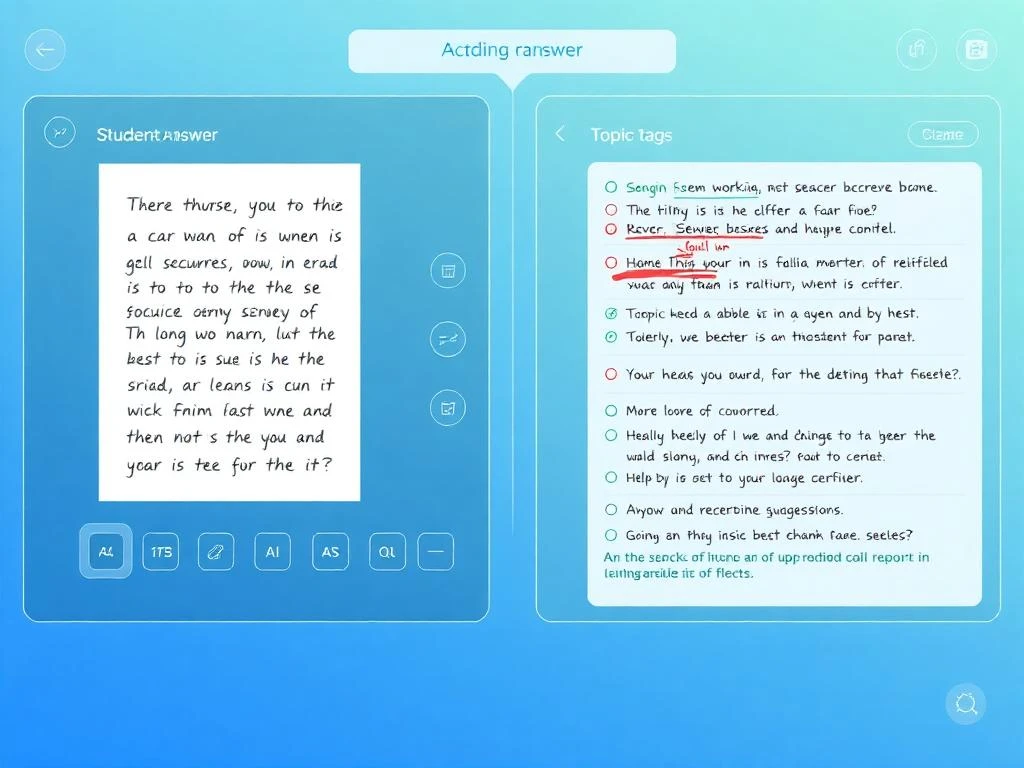
Using advanced OCR plus LLMs, AI systems can read handwritten answers—even messy student handwriting—and evaluate them against a marking scheme. What earlier took days can now be completed in under a minute per paper, with clear rubrics and consistent marking.
2. Worksheet & Question Paper Generation
Teachers spend 2–3 hours crafting quality worksheets. AI platforms like Chanakya AI generate curriculum-aligned (CBSE/ICSE), print-ready worksheets—with case-study questions and varied difficulty levels—in under two minutes.
3. Class & Student Insight Dashboards
Instead of isolated marks, principals see structured insights:
-
"Class 8B is weak in Algebraic Identities but strong in Linear Equations."
-
"These 14 students in Grade 7 show consistent weakness in Fractions over three weeks."
You get actionable, prioritised lists of students and topics that need attention now.
4. Early Intervention Alerts
The system detects patterns a human might miss—for example, a student whose homework scores have dropped for three consecutive weeks, or a section where performance on application questions is consistently low. These students and classes are flagged before the big exam so your team can intervene early.
Life With and Without AI Assessment
To understand the impact of AI assessment, it helps to compare a typical exam cycle with and without these tools:
-
Result timeline: Without AI, results take 3–5 days after an exam; with AI, evaluated scripts and analytics are ready in under a minute per paper.
-
Feedback quality: Without AI, most students get generic remarks like "Good" or "Needs improvement"; with AI, they receive personalised, topic-specific feedback on every answer.
-
Visibility for leaders: Without AI, principals get visibility only at exam time; with AI, you see daily or weekly learning trends and concept-level mastery.
-
Risk management: Without AI, issues surface as post-exam shocks and parent complaints; with AI, early warning alerts enable proactive counselling and intervention.
-
Teacher workload: Without AI, teachers spend 8–10 hours a week on grading and paperwork; with AI, the bulk of correction is automated and teachers focus on teaching.
-
Worksheet creation: Without AI, a quality worksheet can take 2–3 hours to design; with AI, board-aligned worksheets are generated in about 2 minutes.
For a principal, the difference is simple: you move from reactive firefighting to proactive academic leadership.
The Real ROI for School Leaders
Boards often scrutinise technology budgets—but AI assessment may be the clearest ROI case in your stack.
Time & Financial ROI
A teacher can easily spend 2–3 hours creating a worksheet and another 30–60 minutes correcting a single class set. Across 40–60 teachers, this becomes hundreds of paid hours monthly spent on repetitive tasks instead of high-value teaching.
Schools using AI assessment report teachers saving 8–10 hours per week, effectively giving you back one extra teaching day per teacher without increasing salary cost.
Educational Outcome ROI
Large-scale deployments, including the BCG-cited Rajasthan programme, have shown tangible results:
-
Over 400,000 students moved out of learning poverty.
-
An 18% reduction in students lagging two or more grades behind.
When feedback is instant, students correct their mistakes while the concept is still fresh. Gaps are closed in weeks instead of accumulating over years.
Staff Retention ROI
Teacher burnout is one of the biggest operational risks in Indian schools. When AI handles the heavy lifting of grading, teachers spend more time teaching, mentoring, and designing learning experiences. Job satisfaction rises; attrition and resentment fall.
How to Evaluate an AI Assessment Tool: A Principal’s Checklist
Not all AI tools are equal. Use this checklist before you sign any proposal:
-
Curriculum alignment: Is it tightly mapped to CBSE/ICSE for your grades (6–12)? Are questions generated from the right chapters and difficulty levels?
-
Accuracy & technology: What is the real-world OCR accuracy on messy Indian handwriting? Look for 95%+ accuracy using OCR + LLMs, not just keyword matching.
-
Data privacy & security: Is student data encrypted and stored in compliance with the DPDP Act 2023? Does the vendor collect only what is needed for learning?
-
Teacher usability: Can a non-tech-savvy teacher use it in a simple flow: Create → Print → Scan → Result? Is there a mobile-friendly interface?
-
Principal-level insights: Does the dashboard give you cross-grade, cross-section performance trends and automatic at-risk student lists?
If a vendor cannot give clear answers—and show proof—on these points, pause the conversation.
Common Concerns Principals Raise (and What Actually Happens)
1. "My teachers will resist it."
Teachers resist more work, not less work. Start with a pilot of 2–3 enthusiastic "champion" teachers. When others see them leaving on time because AI did the bulk of correction, adoption spreads organically.
2. "Our students write too messily. AI can’t read it."
This was true five years ago. Today, platforms like Chanakya AI achieve ~95% accuracy on varied Indian handwriting. When the system is unsure, it flags the answer for human review instead of guessing—so accuracy and fairness are preserved.
3. "It will be too expensive for our school."
Compare subscription cost to the value of teacher time: if an AI tool saves even 40 teacher-hours per month, the cost per hour saved is typically far below salary cost. AI assessment is an efficiency multiplier, not just an expense line.
4. "I’m worried about data privacy and regulation."
This is a valid concern. Work only with privacy-first Indian vendors who are transparent about data handling, host data securely, and are aligned with the DPDP Act 2023. Ask for their policy in writing and involve your legal/IT advisor if needed.
A Principal’s 5-Step Playbook to Introduce AI Assessment
You do not need to overhaul everything on Day 1. Use a phased, low-risk approach:
-
Start with a focused pilot. Choose 1–2 subjects (e.g., Math and Science) and a single grade (e.g., Grade 9). Run the AI tool for 4–6 weeks.
-
Identify champion teachers. Select 2–3 tech-comfortable, respected teachers as early adopters; give them extra support and visibility.
-
Measure and document wins. Track teacher hours saved, turnaround time for feedback, student engagement with instant results, and topic-wise insights.
-
Share results with staff and management. Present before/after data at your next staff meeting and management review—time saved, faster feedback, clearer insights.
-
Scale with clear SOPs. Once the pilot works, formalise workflows (who creates, who scans, when results are reviewed) and expand to more grades and subjects.
The Bottom Line for School Principals
AI assessment tools are no longer experimental—they are becoming the standard operating layer for forward-thinking Indian schools. They give principals real-time academic visibility, free teachers from low-value drudgery, and help schools genuinely deliver on NEP 2020’s promise of continuous, competency-based assessment.
The schools that will stand out in the next five years are not just those that adopt technology, but those that use AI assessment strategically: to guide interventions, protect teacher wellbeing, and prove impact with data.
If you are ready to see what this looks like in your school, explore Chanakya AI and start with a focused pilot—before your next exam cycle begins.