Bridging the Gap Between Online Learning and Handwritten Board Exams: How Chanakya AI Helps Schools Build Scalable Board Readiness
Indian schools have invested heavily in digital teaching infrastructure, from LMS platforms and recorded lessons to online practice systems and smart classrooms. But the country’s most important assessment system has not evolved at the same speed. CBSE and ICSE board exams are still handwritten, step-based, and presentation-sensitive. Marks depend on visible working, structure, keywords, and clarity, not just conceptual familiarity.
At this scale, the issue is no longer about individual classroom effort alone. It is an institutional challenge. CBSE projected around 26.60 lakh Class X students and around 20 lakh Class XII students for the 2026 examinations. That means tens of lakhs of handwritten answer sheets in a system where evaluation still depends on written execution.
When readiness depends on pen-and-paper performance, schools need a practical way to build writing discipline, strengthen academic integrity, and track mastery across classes and sections. This is where Chanakya AI fits in. It helps schools operationalize handwritten evaluation in a way that is exam-aligned, scalable, and designed to support teachers rather than replace them.
The Structural Mismatch in Indian Schools
Indian schools have modernized instruction quickly. Smart classrooms, digital resources, recorded teaching, LMS platforms, and online practice are now common across many institutions. Yet the assessment system that matters most for academic outcomes remains largely unchanged. This creates a structural mismatch for school leaders. Teaching is becoming more digital, but evaluation is still decisively handwritten.
In the CBSE and ICSE ecosystem, board exams remain high-stakes, handwritten, and step-mark based. Students may understand a concept through digital learning, but their final marks depend on what appears on the answer sheet. That is why AI-powered handwritten evaluation is no longer just another edtech feature. It is becoming a serious requirement for schools that want to align teaching methods with assessment realities.
The Mismatch and Evaluation Reality
These realities are well understood by principals and exam coordinators. Step-wise marking rewards method, not just the final answer. Presentation, formatting, keywords, and structured writing directly influence marks, especially in theory-heavy subjects. In many cases, diagrams, labels, units, headings, and layout determine whether full credit can be awarded.
This is why the response must be institutional rather than informal. Board readiness cannot be left only to individual teacher effort. Schools need curriculum-aligned evaluation standards, mastery tracking, and a repeatable feedback system that improves handwritten performance at scale.
The Operational Challenge for Schools
Most CBSE and ICSE institutions work with large class sizes, multiple sections, and limited teacher bandwidth. Teachers are expected to complete the syllabus, conduct tests, support remediation, handle parent communication, maintain documentation, and manage classroom responsibilities across many students.
In such an environment, the time available for deep, exam-aligned correction is limited. Even when teachers want to provide detailed feedback on method, structure, keywords, and presentation, the school timetable rarely supports that level of consistency.
This creates the notebook-checking bottleneck.
Proper notebook correction is time-intensive, especially in step-marked subjects where every stage of method and working matters, and in theory subjects where structure and language influence marks. As workload rises, inconsistency becomes inevitable. Some notebooks receive detailed remarks, others receive quick ticks, and many receive feedback much later than ideal.
Those feedback delays weaken the improvement loop. By the time students receive correction, they may already have repeated the same mistake several times. Gaps then become habits.
Why Even Strong Teachers Cannot Solve This Alone
The most important observation is this: even experienced teachers cannot solve this problem alone. Not because of a lack of capability, but because of scale.
Detecting concept-level patterns across hundreds of notebooks is extremely difficult manually. Repeated misconceptions, missing keywords, and recurring step errors are hard to track consistently.
Creating personalized remediation plans for every student is operationally unrealistic when each learner needs different next steps.
Tracking writing improvement over time, including structure, clarity, presentation, and speed, requires organized data, not isolated notebook remarks.
The outcome is predictable. Weaknesses are often discovered too late, usually during pre-boards or final revision, when there is limited time to rebuild fundamentals and strengthen writing discipline. Schools then shift into reactive remediation instead of early mastery-building.
This is exactly why online practice alone does not solve the board-readiness problem.
Why Online Practice Alone Is Not Enough
Online practice is useful. It increases exposure to questions, improves recall speed, and helps students revise large parts of the syllabus quickly.
But MCQs and digital quizzes mostly train recognition, not production.
Students learn to identify the right answer, but board exams require them to write the answer clearly, step by step, and in a format that earns marks. That is where digital-only preparation often falls short.
I. What CBSE and ICSE Board Exams Actually Reward
In handwritten board assessments, examiners award marks for visible evidence of understanding, not only for the final result. Schools repeatedly observe the same pattern: students who perform well in digital practice can still underperform in written exams because they have not developed disciplined answer-writing habits.
Board exams reward:
-
Step clarity, with complete method rather than skipped working
-
Logical sequencing and coherent flow
-
Presentation and structure, including neat layout and readability
-
Keywords and definitions aligned with board expectations
-
Working process, diagrams, labels, and units wherever relevant
This is not mainly a content problem. Most schools already have experienced teachers, strong instruction, and enough syllabus coverage. The gap is operational. It is a practice-and-feedback loop problem.
Without sustained handwritten practice and consistent checking, students do not receive timely correction on missing steps, weak structure, or recurring conceptual mistakes. Without mastery tracking, schools also lack early indicators of who is improving and who is falling behind.
The institutional takeaway is clear. Schools need a system that combines regular handwritten practice with timely, curriculum-aligned evaluation, along with visibility into concept-level patterns across sections and grades.
That is the role Chanakya AI is built to play.
How Chanakya AI Supports Handwritten Board Readiness
Chanakya AI is designed as a school support layer, not as a replacement for teachers, classrooms, or notebooks. Its purpose is simple: strengthen evaluation infrastructure so handwritten practice becomes consistent, measurable, and scalable across sections.
Teachers continue to lead instruction, doubt-solving, and academic judgment. Chanakya AI supports the part that becomes hardest to manage manually at scale: fast, board-aligned evaluation with actionable feedback.
1. What Chanakya AI Provides
-
CBSE-aligned evaluation logic built around board-style expectations and step-wise marking patterns
-
ICSE-aligned evaluation support tailored to answer format, structure, and marking emphasis
-
Step-wise handwritten answer analysis that looks beyond the final answer and checks process, working, and reasoning
-
Concept-level mistake detection to surface the underlying misunderstanding behind repeated errors
-
Structure and presentation analysis covering clarity, format, sequencing, keywords, and diagram or label discipline where relevant
-
Fast feedback cycles that allow students to correct mistakes while their reasoning is still fresh
2. A Simple, Repeatable Workflow
The workflow is practical and school-friendly.
-
The student writes answers in a notebook or on paper.
-
The page is uploaded as an image or PDF.
-
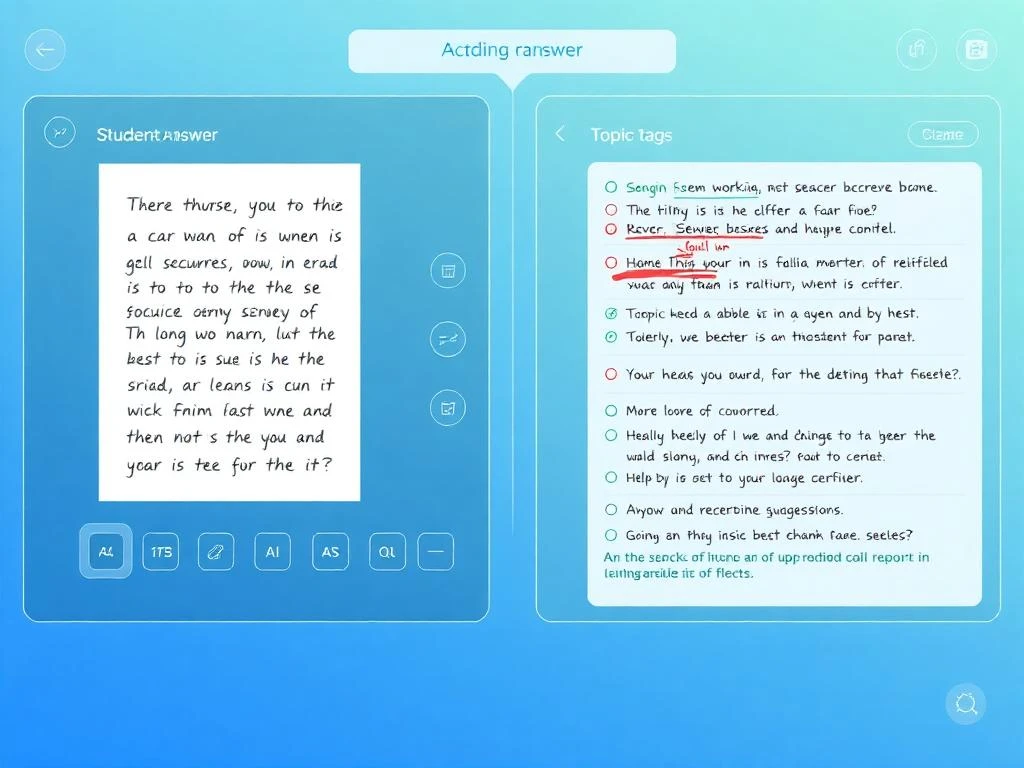
Chanakya AI evaluates the response using board-aligned criteria.
-
Detailed feedback highlights missing steps, concept gaps, and presentation issues.
-
Students receive targeted practice recommendations for what to improve next.
-
The page is uploaded as an image or PDF.
-
Chanakya AI evaluates the response using board-aligned criteria.
-
Detailed feedback highlights missing steps, concept gaps, and presentation issues.
-
Students receive targeted practice recommendations for what to improve next.
-
For school leaders, the value lies in consistency and visibility. Schools can create board-oriented writing practice without relying only on manual notebook-checking capacity, which often varies by section strength, timing, and workload.
3. Institutional Benefits for Principals
Chanakya AI helps schools move toward:
-
Uniform evaluation standards across sections
-
Reduced teacher correction burden
-
Faster feedback cycles that strengthen the practice-to-correction loop
-
Curriculum-aligned marking standards that reflect how marks are actually awarded
-
Student-level concept analytics that support mastery tracking, early warning signals, and targeted remediation
This matters because it turns evaluation from an occasional task into a structured academic system, one that supports scalable personalization without adding operational strain.
From Evaluation to Mastery: Institutional Impact
When evaluation is slow or inconsistent, schools are forced into a reactive mode. Gaps are discovered late, remediation becomes rushed, and teachers spend valuable time re-teaching instead of building mastery from the beginning.
Chanakya AI changes that operating model.
With AI-assisted handwritten evaluation, the system shifts from correcting what already went wrong to preventing weak areas from compounding.
One of the biggest benefits is early detection. Because handwritten responses are checked consistently and step-wise, weak topics and recurring misconceptions surface earlier, often while a chapter is still being taught.
Instead of waiting for unit tests, pre-boards, or boards, schools can identify students who are missing key steps, using weak structure, misapplying formulas, or repeatedly avoiding required keywords. Just as importantly, recurring patterns become visible across classes and sections, giving academic teams time to intervene before performance issues show up in school-wide metrics.
What Principals Gain: Visibility and Control
Schools can assign targeted worksheets based on actual learning gaps rather than generic revision.
Handwritten practice can be expanded without increasing manual checking burden, because evaluation is no longer tied only to teacher bandwidth.
Improvement becomes measurable over time, allowing schools to track progress beyond one-off marks.
For principals, the value is not merely faster correction. It is stronger academic decision-making. Schools gain:
-
Student-level performance dashboards that show readiness trends
-
Topic-wise mastery tracking across subjects and grades
-
Early warning signals before pre-boards and board exams
-
Data-backed planning inputs for remediation, revision, and targeted intervention
This turns evaluation into academic infrastructure. Schools move from sporadic feedback to a more reliable practice-and-improvement loop that strengthens written performance consistently.
Unlimited Practice. Instant Evaluation. Scalable Personalization.
In most schools, the real limitation is not willingness. It is capacity.
The traditional model can support only a certain amount of handwritten practice because correction bandwidth is finite. Worksheet checking depends on teacher time. Feedback may come after several days. Checking quality may vary due to fatigue and workload. And in many schools, there is no reliable revision-tracking loop that shows whether the same student corrected the same mistake over time.
As a result, practice becomes irregular, feedback becomes inconsistent, and improvement becomes harder to sustain.
What Chanakya AI Enables
Chanakya AI helps remove the evaluation bottleneck while keeping handwriting central to the learning process.
With Chanakya AI, schools can support:
-
Unlimited worksheet generation aligned with syllabus and board-style expectations
-
Frequent evaluation cycles without being constrained by checking bandwidth
-
Re-attempts and iterative improvement instead of one-time correction
-
Fast feedback turnaround
-
Continuous improvement loops supported by targeted remediation
-
A practical academic cycle of Practice -> Feedback -> Correction -> Reinforcement -> Mastery
This is where scalable personalization becomes real. Each student can receive practice and feedback matched to their actual gaps, while principals maintain standardization across sections and teachers avoid repetitive correction overload.
The key advantage is that this can happen at scale without increasing teacher workload. Schools can increase handwritten practice frequency, shorten feedback cycles, and standardize evaluation quality at the same time.
The Strategic Shift: Hybrid Academic Infrastructure
The shift schools need is not disruption. It is modernization of academic infrastructure.
This model does not replace teachers. It does not replace classrooms. It strengthens what already works in CBSE and ICSE schools by adding a reliable evaluation and remediation layer that is hard to maintain consistently at scale through manual processes alone.
The Four-Part Hybrid Academic Model
A practical hybrid academic model has four parts:
-
Human instruction
-
Handwritten execution
-
AI-supported evaluation
-
Data-driven remediation
This model fits India’s exam reality because it preserves handwritten discipline and board-aligned rigor while adding speed, consistency, personalization, and analytics. It upgrades the feedback loop without changing the assessment medium.
At the school level, implementation can be gradual and manageable. Schools can begin with selected grades or subjects, such as Classes 9 and 10 Maths or Science, or senior secondary core subjects. Evaluation can be integrated into weekly written practice and pre-board preparation cycles, while standards are aligned across sections.
Closing: A Leadership Question
As digital instruction becomes increasingly common across CBSE and ICSE schools, the most important leadership question is no longer whether technology has been adopted.
The real question is this:
Are students simply participating in digital learning, or are they being systematically prepared for handwritten board performance?
Because in the end, board outcomes still depend on what students can produce on paper: step clarity, structure, presentation, and exam-time execution.
The opportunity for schools is clear. Institutions that treat board readiness as a system, by building writing discipline, strengthening feedback loops, and operationalizing mastery tracking, reduce last-minute remediation and improve result predictability.
Chanakya AI is designed to support that shift. It acts as an academic infrastructure layer for evaluation, remediation, and analytics. It helps schools deliver faster feedback, more consistent standards, and actionable academic insight, while reducing pressure on teachers and improving long-term learning outcomes.
FAQs
1. What is AI-powered handwritten evaluation for CBSE and ICSE schools?
It is a system that evaluates students’ handwritten notebook or answer-sheet responses using board-aligned criteria such as steps, working, structure, keywords, and presentation. Chanakya AI helps make this process faster, more consistent, and more scalable for schools.
2. How does this help schools improve board readiness at scale?
It allows schools to run frequent handwritten practice with timely evaluation, even across large class sizes and multiple sections. This improves step clarity, writing structure, presentation, and overall exam readiness.
3. Does Chanakya AI replace teachers or notebook checking?
No. Chanakya AI supports teachers by reducing repetitive correction workload and improving feedback speed. Teachers remain central to instruction, academic judgment, and classroom learning.
4. What does the system evaluate in a handwritten answer?
It evaluates step-wise working, correctness, logical flow, required terminology, structure, presentation, and format-related elements such as diagrams, labels, and units where relevant.
5. What is mastery tracking, and why does it matter for principals?
Mastery tracking helps schools understand topic-wise progress over time, including recurring mistakes, weak concepts, and improvement trends. This helps principals and coordinators identify early risks and plan better remediation.
6. How can schools standardize evaluation across multiple sections?
By using common, curriculum-aligned evaluation criteria and consistent feedback frameworks. Chanakya AI helps reduce variability caused by workload and fatigue, making evaluation more reliable across classes.
7. What might a school implementation or demo include?
A typical demo would show the end-to-end flow: handwritten response upload, board-aligned evaluation, concept-level feedback, targeted remediation suggestions, and dashboards for mastery tracking and early-warning visibility.
See What Scalable Board Readiness Can Look Like in Your School
If your classrooms are becoming more digital but your board outcomes still depend on handwritten, step-wise performance, the challenge is not just teaching. It is readiness.
Chanakya AI helps schools build a stronger bridge between digital learning and handwritten board performance through structured evaluation, faster feedback, targeted remediation, and measurable mastery tracking.
Explore how a school-wide workflow can support notebook-based practice, standardized evaluation, and better academic visibility across sections without disrupting teaching.